
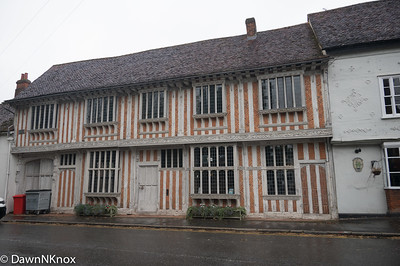
Visit to Paycocke’s House in Coggeshall, Essex
The other day my husband and I passed through Coggeshall in Essex. We were on our way to the National Trust Medieval Grange Barn to watch a brilliant performance of Pygmalion by DOT Productions (check out their website for future performances here). I’d previously looked up Grange Barn on the National Trust website and seen another historic site in Coggeshall – Paycocke’s House – and as we drove through Coggeshall, I spotted it. Not a mansion nor a stately home but a Tudor merchant’s house with an intriguing façade. See National Trust site here. Something interesting that I learnt from the site is that ‘Paycocke’ is the Old English for ‘Peacock’.
A few weeks later, on the spur of the moment, we decided to go back to Coggeshall to have a better look at Paycocke’s House and some of the other Tudor buildings in the town. When we arrived at Paycocke’s House, the garden and teashop at the back were just opening and we discovered there were guided tours taking place throughout the day. Although they were full, the guides kindly allowed us to join the first group of eight.
Anne was our voluntary guide and she led us from the garden into the street to admire the façade and the many wooden carvings on the beams. She pointed out the fool and the mummer figures over the coach entrance. It’s not known why Thomas Paycocke, the merchant who built the main part of the house, had those particular figures represented on the front of his house. However, links can be seen with many of the other carvings depicted on the beam that runs from one side to the other. The ermine emblem that Thomas Paycocke used as his merchant’s mark on the woollen cloth that he produced can be seen, as well as his initials. There’s also an upside down dragon (possibly showing it’s dead), a cat, a child looking as though it is being swallowed by a flower, a phoenix and the two headed swan of the Vintners Guild who are associated with swan-upping each summer along the River Thames, to name but a few.
Our tour continued as Anne unlocked the front door and we entered the Great Hall where she pointed out more carvings in the ceiling beams including the initials of Thomas and his wife Margaret.

The room leading off the main entrance hall is called the Panelled Room with magnificent linenfold panelling on the walls and a desk set up to look as though it were ready for the merchant to do business. It is covered with a carpet, as was the custom in those days, and on top are items such as Thomas might have used while conducting his business.

We then went upstairs to the Great Chamber, a room containing a dining table and chairs, and Anne explained how important the wool trade was to the area, with the many different trades involved from rearing sheep to spinning, carding, weaving, fulling and so on. She demonstrated how to card wool, repeatedly combing the wool between two brushes and teasing out the lengths of wool to ready them for spinning into yarn. She allowed us to touch some of the white, woollen cloth such as Thomas Paycocke would have produced and which would have earned him a handsome profit. I was surprised that to the touch, it was rather like felt. From there, we passed into a smaller room containing more woollen samples and then into a bedroom. The last part of the tour was the solar containing examples of lace. If you’d like to see more photos of the visit, you can see them here.
Anne told us that the house had undergone many changes over the years – at one point, even being split into three cottages and it is possible to see the bricked up doors in the façade. In 1904 the house was in a poor state and Lord Noel Buxton paid for it to be completely renovated. He subsequently gifted it to the National Trust. She also told us that the interesting windows were not original features, having being added many years after Thomas Paycocke had the house built.
Anne was an excellent and knowledgeable guide and brought the house to life. Definitely worth a visit if you’re anywhere near Coggeshall in Essex.
Although I’ve never written anything set in the Tudor times, it’s wonderful to be somewhere so old and to soak up the atmosphere! Perhaps Paycocke’s House will inspire me to write a story!