
A few weeks ago, I decided to investigate another Regency walk from the book, ‘Walks Through Regency London’ by Louise Allen (you can find it here). I was going to have lunch with the ladies of the London & South East chapter of the Romantic Novelists Association and wanted to do a walk before I met them.
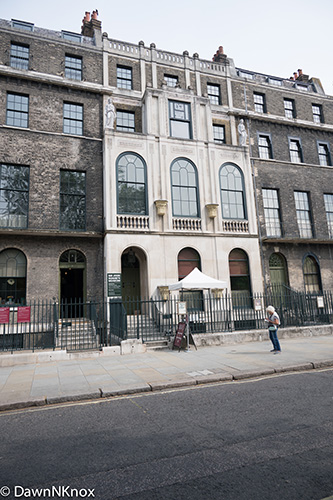
I selected a route and then discovered that it passed a museum I’d never visited, so I thought I’d go there instead and save the rest of the walk for another time. The museum I decided to visit was the Sir John Soane‘s Museum in Lincoln’s Inn Fields. Sir John Soane (1753-1837) was a renowned architect. You can see a list of his buildings here. He bought three neighbouring houses, nos. 12,13 and 14, demolished them then rebuilt them. He lived in no. 13 and that one became the museum.
If you write stories set in the Georgian or Regency times, it’s easier to imagine the characters in your stories exchanging pleasantries whilst sipping tea and nibbling cakes, if you’re surrounded by authentic decoration and ornaments. I was hoping to immerse myself in the Georgian world and take a few photographs to remind me later. In a Georgian architect’s house, I’d expected gorgeous rooms with lofty ceilings and tasteful decoration. What I actually got was something rather more unusual than that!
The first room was the dining room and library and it lived up to my expectations – grand and tasteful – but as I left that, I entered a narrow passage, which surprisingly contained a writing desk. A strange place to have a desk because it was in a small room that linked two much larger rooms, so whoever wrote at the desk might have constantly found people coming and going past them. Then I entered the next room which was so crammed full of stone statues, busts and other figures, I almost felt claustrophobic!

I’ve never been in a museum store room but that’s how I imagine one to be. I moved further into the room to find the Dome Area (see picture). Surely, a housemaid’s nightmare.

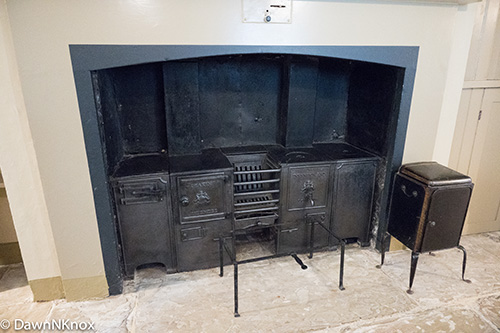
I continued to explore the house, going upstairs to find more of the sort of rooms that I’d expected – like stately drawing rooms. I also went down to the basement where the kitchens were. Yes kitchens. There were two. The first one I entered, was apparently the wet kitchen, so the guide informed me. It contained the oldest patent range in the world. The front, or dry, kitchen was where the food preparation took place and there was another range in there.
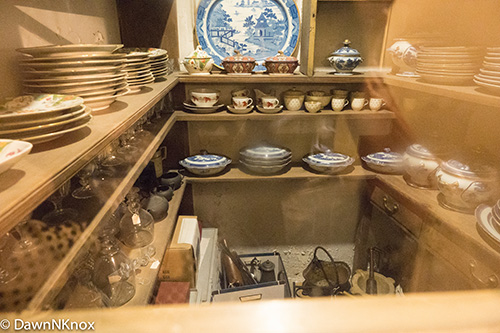
Leading off the front kitchen was the china cupboard which was locked. I could only take a photograph through the window. The guide told me that the collection had been much depleted after Sir John died. The servants had been allowed to live on in the house after his death and lots of pieces disappeared then. I’m not sure whether they were removed or broken, or perhaps both.
Also in the basement was the sarcophagus of King Seti I. Apparently, when Sir John rebuilt no. 13, he replaced the basement cellars with the Sepulchral Chamber and his own homage to the catacombs of Ancient Rome. A rather sobering experience!
The Picture Room was fascinating, and was absolutely crammed with – not surprisingly pictures – including several by William Hogarth and Canaletto. Another remarkable room was the Monk’s Parlour. It was very dark and Gothic and apparently Sir John took his guests in there after dinner to serve them tea. It also contained Robert Walpole’s desk beneath magnificent stained glass windows.
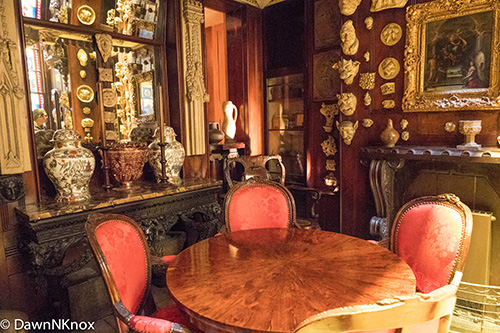
Each room was a surprise, which is perhaps what Sir John intended and in fact, it was such a surprising house, that I had trouble finding my way out when I had to leave!
If you’re in London, near Lincoln’s Inn Fields and you have time, the Sir John Soane’s Museum is definitely worth a visit – and it’s free.
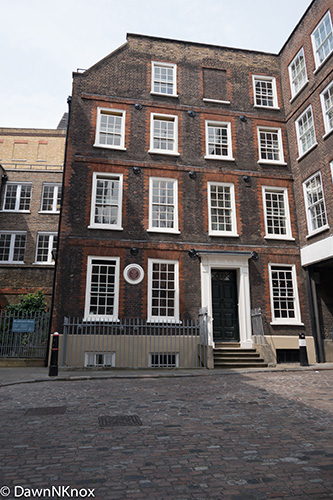
After that, I walked to Fleet Street. I still wanted to find some of the items on the walk that I’d originally been going to do, and one of those was Dr Samuel Johnson’s house. From my map, I could see it wasn’t far from Fleet Street and access was via an alley. I found Johnson’s Court and there was a helpful sign pointing to Samuel Johnson’s house. After several twists and turns I came to an open area and spotted a blue plaque that told me it had been a site of Samuel Johnson‘s house (1765-1776).

I felt rather cheated having expected to see a house. However, I then spotted another sign pointing to Samuel Johnson‘s house. I followed that round another two bends and there it was – a rather fine house. I didn’t have time to go in, although I did find his cat. The statue of Hodge was in the square.

If you’d like to see more of the photos I took on my trip to Sir John Soane’s Museum, you can see them on Flickr, here
Leave a Reply