
The Pantheon and the the Ancient Order of Druids

Carrying on with my Regency walking tour using information from the book ‘Walks Through Regency London’, by Louise Allen, I left Berners Street (see here for previous post about the hoax that may or may not have taken place there.)
The instructions were to cross to the south side of Oxford Street. For anyone, like me, who doesn’t carry a compass and who is walking along Oxford Street in overcast weather, you’ll find the south pavement is the opposite side to Berners Street. I must admit when I read the details that told me the building I was looking for currently housed Marks & Spencer, I thought it was the other store in the opposite direction (towards Marble Arch) and on the opposite side of the road (presumably the north side) and I thought that since it was only a building on the site of what had once been the Pantheon, I might not have time to do it.
However, as I walked towards Poland Street, having made up my mind to skip the Pantheon, I realised I was passing another Marks & Spencer store. I wondered if perhaps this was the correct building – so took a photograph in case. Indeed, when I got home and checked, I discovered this is the site of the original Pantheon, built in 1772. Photos I found on the Internet of this current building, show the words ‘The Pantheon’ at the top but as you can see on my photo, they are no longer there.
So, what was the Pantheon? Well, it was a grand building erected for masquerades, assemblies, exhibitions and concerts. The author of ‘Walks Through Regency London’ says that it also hosted scandalous Cyprians’ (Courtesans’) balls, however, so far, I haven’t been able to find any other evidence supporting that. The main rotunda was one of the largest rooms built in England up to that time and had a central dome somewhat reminiscent of the celebrated Pantheon in Rome – hence the name.
After a fire in 1792, it was rebuilt and in 1813, it became the English Opera House before it was closed by the Lord Chamberlain. In 1833, it was turned into the Pantheon Bazaar with stalls in the main hall and upper gallery. There was also an oriental-style conservatory in which one could buy flowers, exotic plants and animals such as love birds, monkeys, mice and squirrels. In 1867, the building was acquired by W and A Gilbey, wine merchants who used it as offices and showrooms until they sold it to developers in the 1930s. It was finally demolished in 1937 and now, the building with the Grade II listed black ‘ebony’ granite facade belongs to Marks & Spencer.
So, what about the Druids? Well, that was the next part of the tour. Still on the south side of Oxford Street, I carried on and turned into Poland Street where I found the King’s Arms pub,
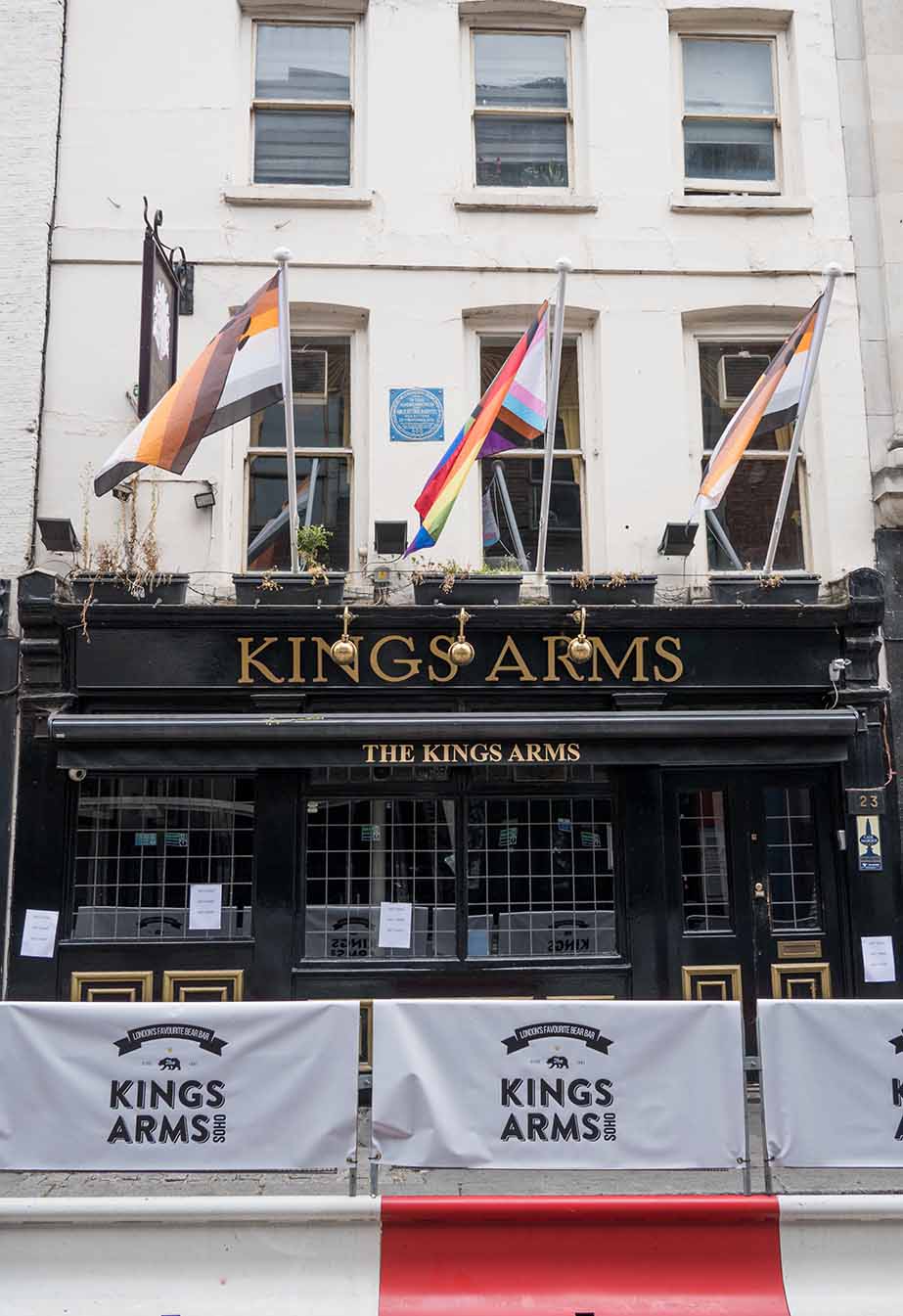
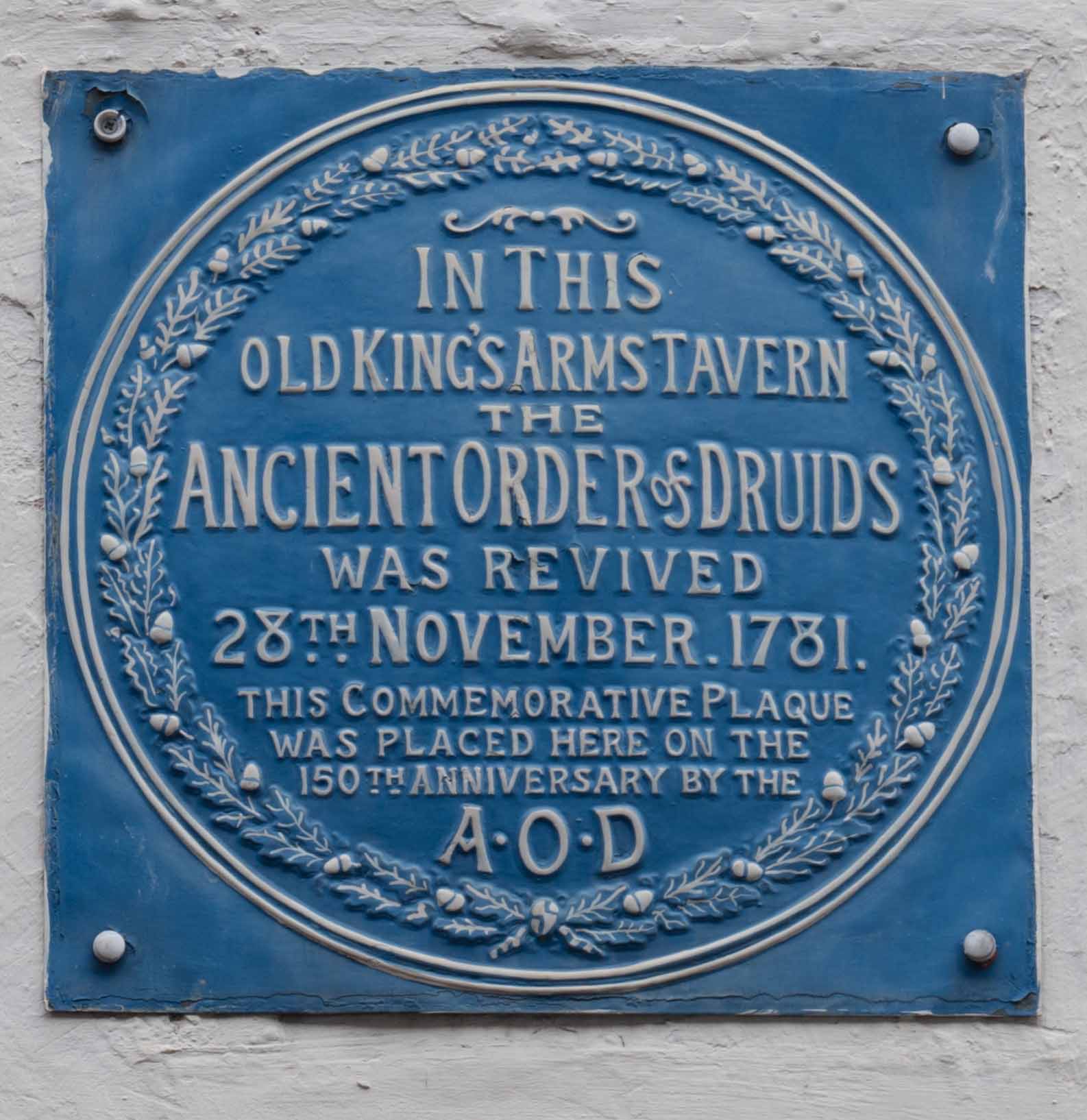
The pub’s claim to fame is that it is the site of the reformation of the Ancient Order of Druids. I looked up the Ancient Order of Druids and found this on the British Museum website here:
The Ancient Order of Druids was founded in London in 1781 by a man named ‘Hurle’, about whom little beyond this is known. The AOD was a fraternal society, modelled on the Freemasons. Interest in the ancient (pre-Roman) druids had been sparked from the early 1700s by the writings of antiquarians such as John Toland and William Stukeley. Drawing on these writings about ancient druids, Hurle constructed an elaborate legend that traced the origins of the AOD back to a fictional ‘Togo Dubellinus’, the son of a Druid priestess, in the first century AD.
The AOD rapidly spread beyond London and developed a national and provincial structure and hierarchy. The founding lodge, of which Hurle was a member, became the ‘Grand Lodge’ with power over the rest of the order. there were also provincial ‘Grand Lodges’.
In 1833, part of the order split off to become a government-registered friendly society, the ‘United Ancient Order of Druids.’ The AOD continued unregulated, as a purely fraternal society, under its original name.
Both the AOD and the UAOD still exist today.
After that, I continued along Poland Street on my Regency tour but more of that in another blog…
Pics of the entire tour can be found here on Flickr