
Wedgwood to the Workhouse – Regency Walk.
Part 4 of my Regency walking tour using information from the book ‘Walks Through Regency London’ by Louise Allen carried on from the pump in Broadwick Street (formerly Broad Street). See the earlier parts of the walk here: Part 1 The Berners Street Hoax here, Part 2 The Pantheon and the Ancient Order of Druids here and Part 3 A Touch of Cholera here
After passing what had once been an early 18th Century Great Plague mass burial pit in Marshall Street and spotting the site where William Blake had been born in 1757, I found myself in a street I associate more with the swinging sixties than the Regency period – Carnaby Street.
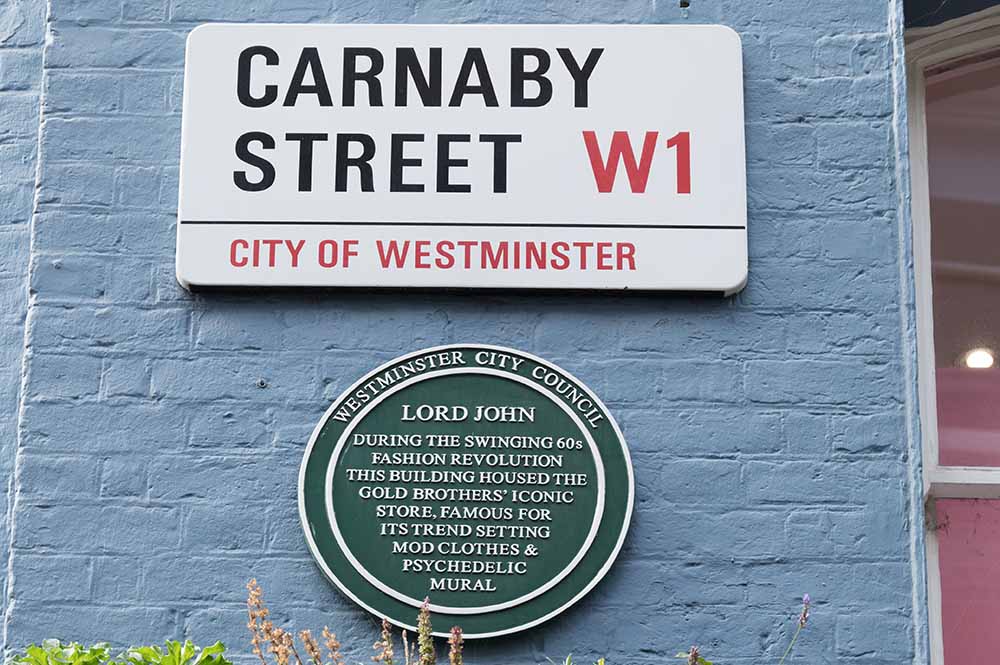
So, what has the street most famous for the latest fashion in the sixties to do with the 18th Century? Well, apparently, the northern end housed Huguenot refugees in the 17th Century and it remained a quarter for shopkeepers and tradesmen into the 19th Century. I wonder what they’d have made of psychedelia!
At the end of Carnaby Street, I turned into Beak Street which was formerly Silver Street. Later, I wondered why anyone would change the name of a street from the perfectly acceptable ‘Silver’ to the rather odd ‘Beak’. Wikipedia told me that the street was renamed after “Thomas Beake, later one of the Queen’s messengers, who, in the late 17th century, obtained the land on the north side, between Regent and Kingly streets. The name Beak Street first appeared in the ratebooks for 1689, and in 1691 it was ordered that the street be paved with stone.” (From Wikipedia here) From that article on Wikipedia, I also noticed that Antonio Canaletto lived at number 41 between 1749 and 1752.
After walking along Beak Street and through surrounding roads, I saw many original 18th Century shop fronts and peered in through the bars of a gate where I should have seen late 19th Century stables with ramps and carriage houses but in fact, I couldn’t make much out at all and had to accept they’d once been there.
There were more 18th Century shop fronts in Greek Street, and one of them, No. 20 still had the original iron hoist.
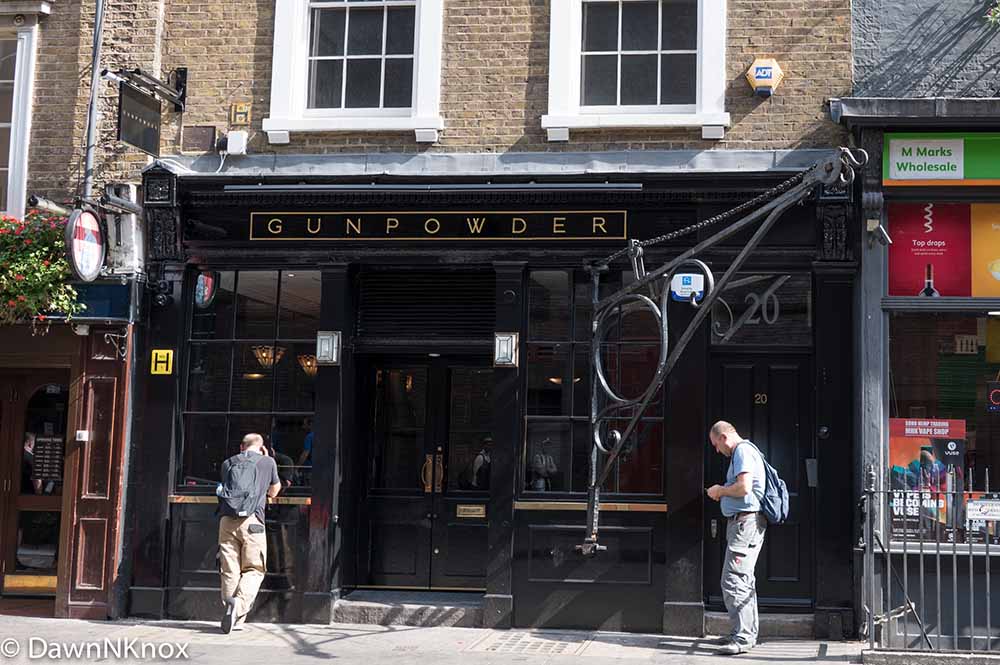
Louise Allen says the property was originally a colourman’s shop. I thought colourmen provided paints and pigments to artists and a search turned up this detailed website The Regency Redingote with lots of interesting facts about colourmen. I’m still not clear why such a large hoist would have been necessary though!
Nearby, in the same street, notable residents included Casanova in 1764 and Thomas de Quincy, author of ‘Confessions of an Opium Eater’.
It took me a while to find the next point of interest which is called Wedgwood Mews. I was looking for a sign but never actually found one. However, the realisation dawned on me when I noticed the windows of the building!

Wedgwood Mews, Soho 
Wedgwood Mews, Soho
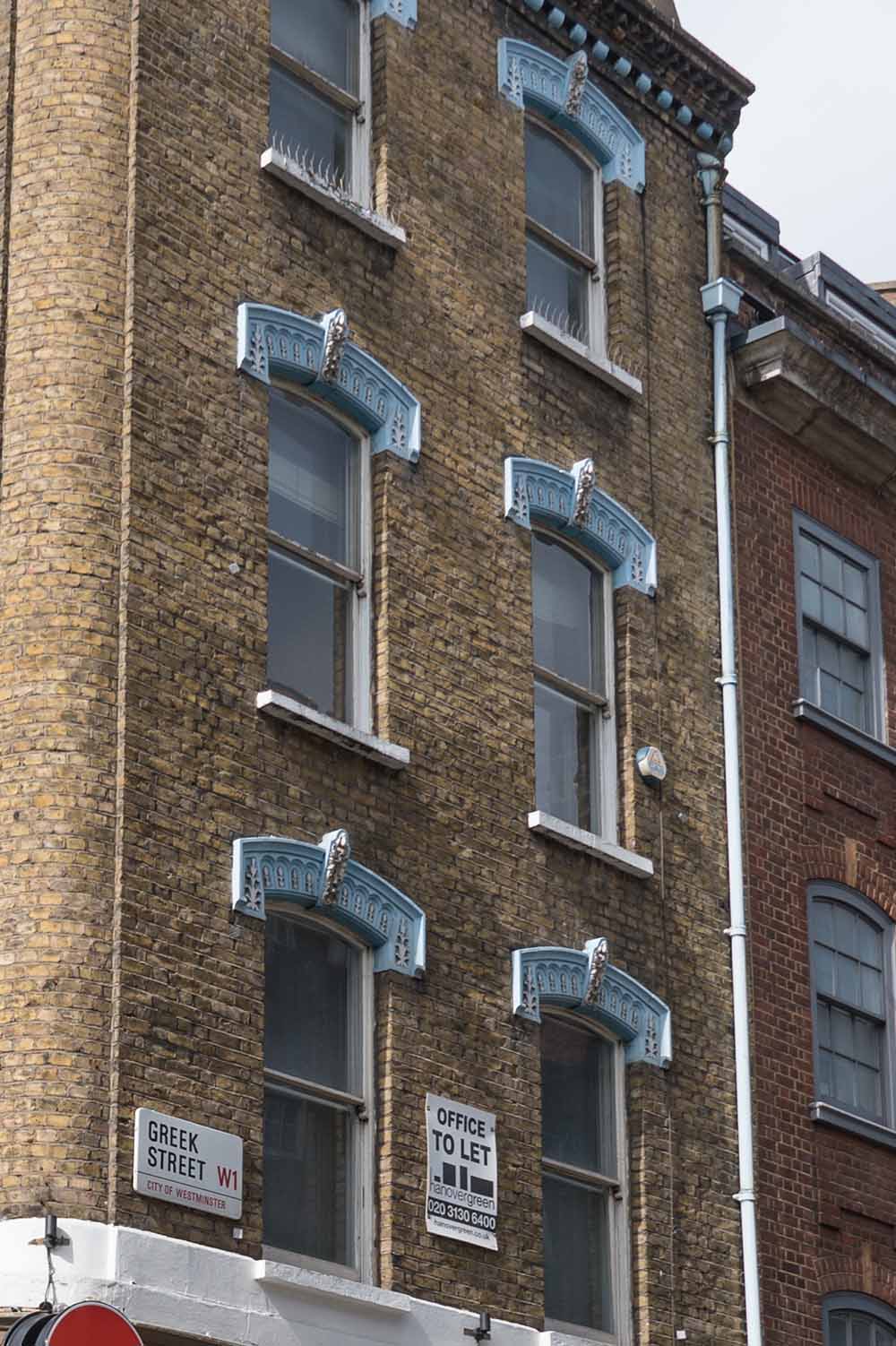
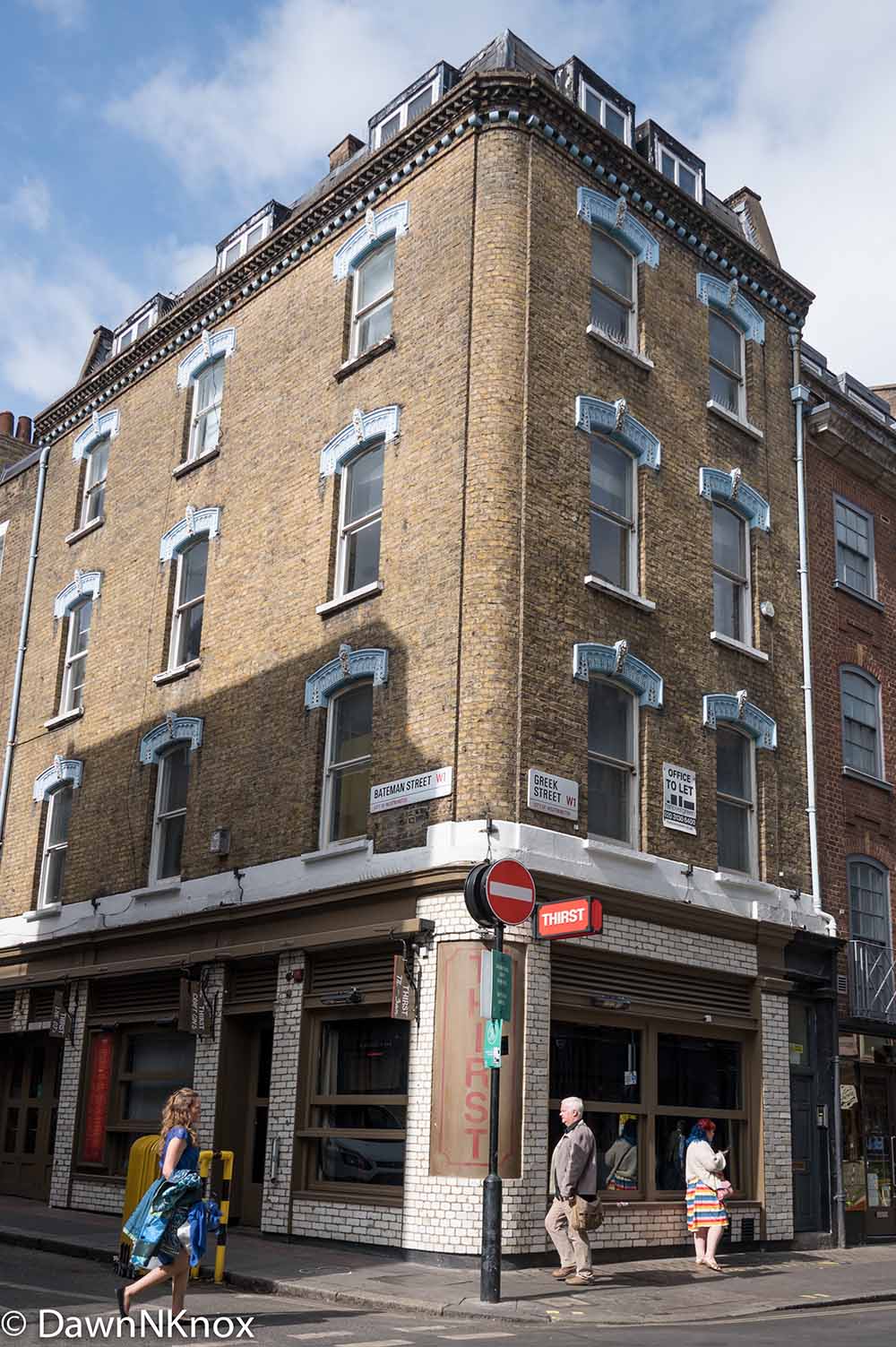
Each window is topped with what looks like Wedgwood decoration and apparently, this was once Josiah Wedgwood’s showrooms from 1774 to 1795 until he moved to St James’s Square.
At the end of Greek Street, where it meets Soho Square, I came across this handsome building – St Barnabus House.
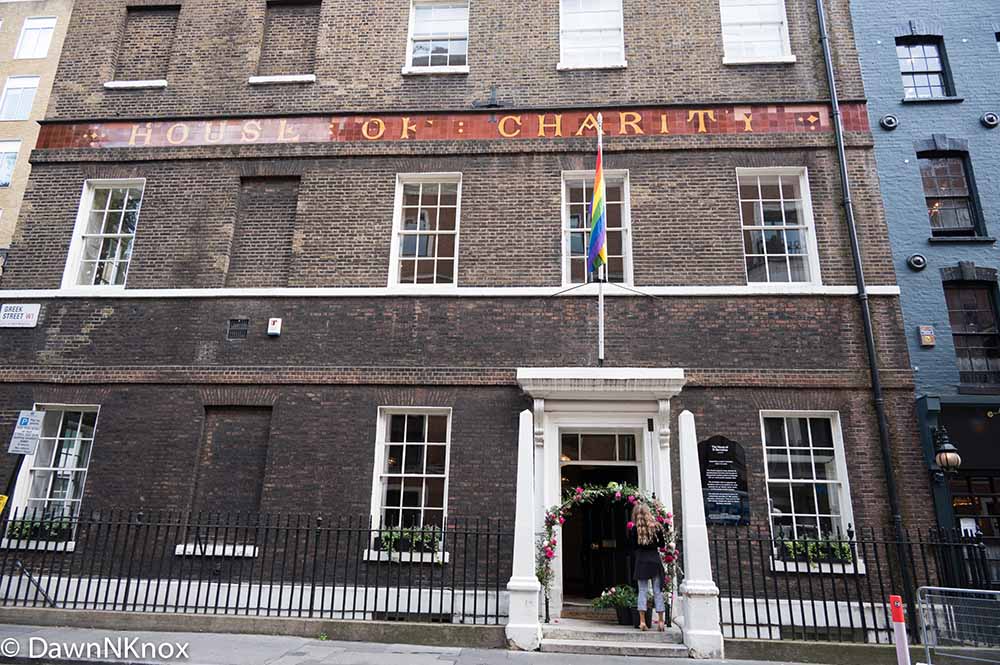
Apparently, it once belonged to Richard Beckford, a Jamaica sugar magnate but is now a charity to help those who have experienced homelessness. Once known as the ‘House of Charity’ (as indicated at the top), it’s now called ‘St Barnabus House’. Research suggests that the rooms and gardens of the House of St Barnabas were the blueprint for the imagined lodgings of Dr. Manette and Lucy in the novel, ‘A Tale of Two Cities’, by Charles Dickens, published in 1859. My next stop was the Pillar of Hercules pub in Greek Street, alongside which is a tiny alley, leading to Manette Street, named after the character in Dicken’s novel. Unfortunately so much building work was going on, it was hard to see the building I was looking for – the late 18th Century St Anne’s parish Workhouse next to the chapel. There wasn’t enough space to move back far enough to take the whole building in.
It was amazing on that short walk around south Soho that I recognised so many names of former residents from the Regency period and other times, such as John Constable who lived in Frith Street from 1810 to 1811, and in more modern times, Peter Cook, famous satirist and comedic actor, who often worked with Dudley Moore. Another Regency resident was William Hazlitt in 1830 who was an essayist, drama and literary critic, painter, social commentator, and philosopher. I must admit to not knowing much about William Hazlitt, so I looked him up and found some of his quotes.
Prejudice is the child of ignorance.
The more we do, the more we can do; the more busy we are, the more leisure we have.
A wise man indeed. Had I known more about him before, I could have visited his grave in St Anne’s Church which was also one of my stopping points. But never mind, because I shall definitely return to do that walk again and perhaps to carry on and do the next tour in the book ‘Walks Through Regency London’ by Louise Allen, which is in south Soho. Hopefully, it won’t be long before I can get back to London…
If you want to see all the photos I took on the day, you can see them here on Flickr
Pingback: New Year's Resolutions - Knox Box of Miscellany