When the party is over, who on earth will put the planet back together?
Well, it depends whether you’re asking a writer or a reader. First, what is Cli Fi? Is it important?
For The Future Brokers, the book that Colin Payn and I co-wrote, the original idea was conceived because Colin wanted to write a book set in the near future to which modern readers could relate. However, he didn’t want it to feature battling aliens, far off planets and wars in space. He also didn’t want it to be a pessimistic story. So, he tried to think of a scenario that would be believable to modern readers. He wanted the characters to be similar to the people around us now, involved in a narrative that didn’t leave the reader feeling gloomy about the future. When he first outlined the story he wanted me to join with him to write, I must admit I was impressed and glad it wouldn’t be a novel that would leave a reader with the idea there was no hope. I generally prefer to read uplifting books to those that finish with a feeling of helplessness. There are several such depressing Cli Fi books – their authors having adopted a pessimistic view, seeing a dystopian future for the Earth.
Other authors have explored what might happen if we continue on the World’s current course. Their aim may be to give a warning to what they believe could or will happen.
So why do readers choose to read Climate Fiction? For myself, I find it interesting to visit the worlds that authors imagine, whether they believe these will come true or not. Some worlds are similar to ours such as in The Future Brokers which is set in London, in 2050—not many years away. Other worlds are found in more dysfunctional stories such as in Margaret Atwood’s Oryx and Crake, set in a post-apocalyptic future.
Once I become immersed in the world the author has created, then it’s interesting to see the problems this presents to the people and communities who live there. How do they deal with the dilemmas and disasters they encounter in their environments? And crucially, at the end of the book where does it leave those people and their communities? Is it something I’d be happy to head towards in the future, or would rather avoid?
Whether you believe climate change is fact or fiction, it’s still a topic that requires global discussion. Cli Fi can be the starting point for that. Graphs, charts, tables and lists can provide scientific evidence but a different and arguably more enjoyable way of engaging with those facts can be to read about them woven into an imaginative tale.
Throughout the ages, storytellers have used their skills to reveal universal truths about the world, providing a medium through which their audience can see how different people share the same life experiences.
For example, Uncle Tom’s Cabin, by Harriet Beecher Stowe brought the horrors of slavery to the public, furthering the abolitionist cause. George Orwell’s 1984 allowed us to glimpse a future world where freedom of thoughts or speech were denied and The Poems of Wilfred Owen exposed the horrors of the Great War to a public who had no conception of the dreadful conditions of the trenches nor the massacres that took place in the No Man’s Land between them. There are many other examples of books that have changed public perception on important social issues.
Perhaps Climate Fiction novels could raise public awareness about changes to our climate. Who knows, it might encourage those who have little interest in scientific data to imagine other possible futures and to feel more invested in their world.
The Future Brokers is available as Kindle, Kindle Unlimited and Paperback here on Amazon
Cli Fi is short for Climate Fiction and is a term first coined by journalist, Dan Bloom, to describe the increasing number of books written about climate change and its effects. Many Cli Fi novels are set in the present or the near future. They explore various scenarios based on what might happen to the planet if world leaders do not act now to implement plans combatting the threat of climate change and the inevitable environmental damage. Some books are distinctly dystopian, telling of disasters and destruction—but by no means all novels have such dark themes and many prefer to tell stories of hope for the future.
Cli Fi stories are usually thought of as belonging to the Science Fiction genre and may also be thrillers, adventures or romances although since Climate Fiction is considered a sub-genre of Science Fiction, many readers assume they are also necessarily full of spaceships and aliens. That’s a shame because many Cli Fi books are based in a world which is easily recognisable today and with which readers might readily identify.
I must admit I was not aware of the term Cli Fi until Colin Payn and I began to write The Future Brokers. It was only when I started to explore other books which had a similar theme, that the term popped up and I became acquainted with the names of other authors and their books. AsColin explained me when he first suggested writing The Future Brokers, “There are plenty of dystopian novels out there which prophesy a war between Mankind and either Artificial Intelligence or robots. I felt that there was another way in which an intelligent organisation could work with humans. And I didn’t want a destroyed world with whizzy spaceships, but something more believable that could happen in the next thirty years. The Future Brokers is based on a possible set of choices that the world is making now, in 2021.”
Well-known authors such as Margaret Atwood with her MaddAddam Trilogy of books, Oryx and Crake,The Year of the Flood and MaddAddam; Ian McEwan with his book, Solar and many others are already established writers in this new genre of Climate Fiction. Annihilation, a novel by Jeff VanderMeer, the first in a series of the Southern Reach Trilogy has also been made into a movie directed by Alex Garland, so Cli Fi stories are also being interpreted for film.
And yet, strangely, Cli Fi or even Climate Fiction are relatively unknown terms despite the fact that Cornwall played host to the G-7 Summit in Carbis Bay between June 11th and 13th 2021 and the UN Climate Change Conference of the Parties (COP26) will take place in Glasgow from 1st to 12th November 2021.
If we’re going to address climate change, we need to think and talk about it. Cli Fi books can be the starting point that prompt discussion. Perhaps one day in the not too distant future, the term Cli Fi will be as well-known as Sci Fi is now.
The Future Brokers by DN Knox & Colin Payn
The Future Brokers by DN Knox and Colin Payn is available as Kindle and paperback here
Paul Burridge of Publishing Buddy designed the cover art for ‘The Future Brokers‘ and prepared the manuscript for uploading to Kindle Direct Publishing. Here, Paul shares some self-publishing advice
Paul Burridge of Publishing Buddy
(For the purposes of this article the term self-publishing, will refer to Amazon Self Publishing/Kindle.)
Self-publishing is what you do after your book has been rejected by traditional publishers. Right? So, let’s start by demolishing the ‘self-publishing is for losers’ myth. The self-publishing revolution begun by Amazon is massively significant. It’s on par with Caxton and the invention of movable type. Maybe more so – we are in the eye of a publishing storm; people just haven’t realised yet.
That’s because, even amid these dramatic advancements in publishing, we remain fixated by the patterns of the past. Traditional publishing, the writer completes a manuscript submits it to a publisher who recognises its genius and publishes it. Didn’t matter if the manuscript was scrawled with a quill or hammered out on a vintage Adler or for that matter keyed in Microsoft Word. You provide the words the publisher provides the book. It’s a two-component process.
We are like the World War One generals fighting today’s battles with yesterday’s strategies. The conventional publishing industry reinforces this attitude. Look at the typical format an agent imposes on a query submission: A4, 12pt Times New Roman, double spaced, ranged left. You’ll never see a book laid out like that. The inference is clear. Demarcation. Words are your business; we’ll take care of the rest. They may use email, but they are stuck in the days when queries were dispatched in sheaves of badly typed foolscap.
Now we come to my big point. Self-publishing is an opportunity, and invitation, to break away from the shackles of the past. Self-publishing requires a whole new mindset. Importantly, thinking like a self publisher will add an extra dimension of creativity and satisfaction to your writing.
But this requires turning the traditional publishing model on its head.
Ask yourself: ‘What’s the last consideration of a writer?’ The book cover design, of course. That’s a publisher’s job, right? That’s a job for an artist not a writer.
Not anymore, that’s your job now.
This is a brilliant exercise to clarify a writer’s thinking. Envision a single image which encapsulates the subject of your book. Something that not only accurately represents your subject but gives it market appeal. Constantly revisit (or adjust) that image as you write.
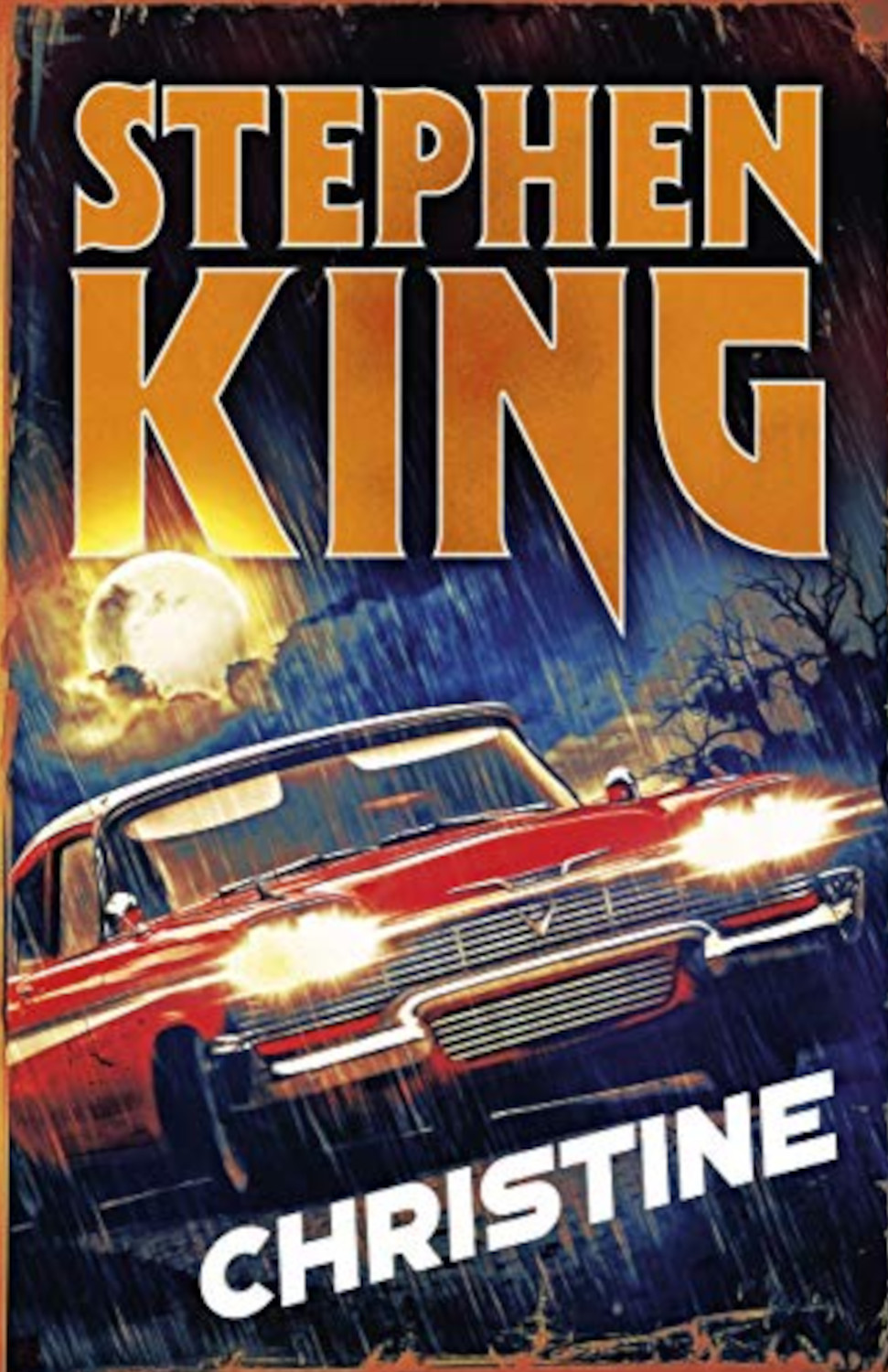
Christine by Stephen KingMoby Dick Cover by Herman Melville
Cover design as an afterthought so often relies on a montage of imagery, that’s just the product of woolly thinking. Someone has lost the plot – literally. A single powerful image is the one punch KO of the graphical world. So, if you are writing about, say, about a forest. Your go-to image will be a tree. Tell me that’s not what’s happening with Stephen King’s ‘Christine’ or Herman Melville’s ‘White Whale’.
Death of Souls by Saul Ben
Now what’s the next last consideration as a writer? The typography. That’s a publisher’s job, right? That’s for a typesetter not a writer.
Not anymore, that’s your job now.
Again, this comes with a benefit. To understand how typography can help a writer, we need to address to the basics of written communication. Those strange abstract squiggles on the page which miraculously cause images and emotions to arise in the mind. Those 26 individual shapes, collectively forming a pattern evoking meaning. Simple equation – shape = meaning. This doesn’t just apply on a micro level (individual letters/words) it’s also applicable to the macro level the shape the letters form on your page, and ultimately to the shape of your manuscript. Writers should learn to be playful with their typography. Modulate sentence, paragraph, section, and chapter lengths. Write shorter punchier dialogue, or longer, whatever suits. Maybe break a few conventions for the sake of visual appeal. Maybe invent a few of your own. As long as what you do forms a logical consistancy you’ll be fine. Always keep in mind shapes convey emotion and pace.
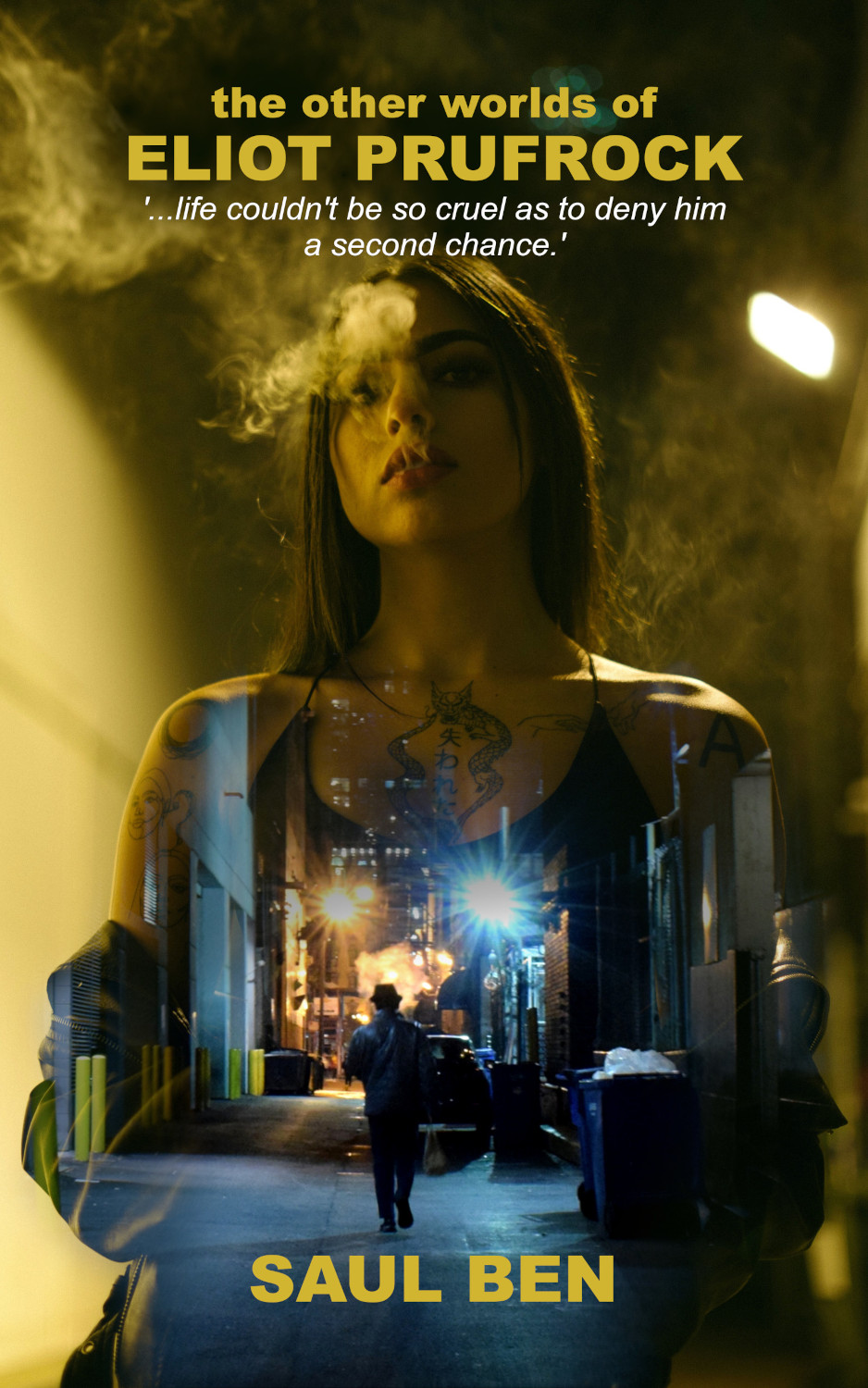
The Other Worlds of Eliot Prufrock by Saul Ben
Here’s a few lines from one of my books (in this case I’m purposefully favouring triangles) …
‘So that’s your limo?’ said the barmaid.
‘I have temporary use of it,’ I said.
‘And the goons minding it?’
‘They’re on staff.’
‘Whose staff?’
‘Mine.’
‘Ah.’
Indifferent typography can render a book unreadable. Creative typography can be inspirational. For a self-publisher typing in double spaced twelve point across an A4 page is plain dumb. You have no impression of the final appearance of your book.
The quick and dirty way to get a book feel to your manuscript is to simply jack your text up in size. Between 16pt and 18pt depending on the font. You’ll need to be looking for 32 lines on the page and an average line length of 11-12 words.
The Future Brokers by DN Knox & Colin Payn
The absolute best way is to type directly into a book template. That involves opening an Amazon account (cost free), choosing your page size and downloading a template. They come in two varieties plain, that is empty, and with sample text. Best way is to get the sample text version and type over the text. (You’ll notice that the gutter is wider on the right of a left-hand page and vice versa.) This provides you with a ‘what you see is what you get’ version of your book as you type.
The Future Brokers by DN Knox & Colin Payn
Then the fun starts. When you have finished your story it’s time to start killing the widows and orphans (typographically speaking). Nothing looks less professional than a single word left over at the end of a chapter, or even a single line. You want your dialogue to flow, you don’t want to have to turn over a page to see the last dramatic word of a sentence. Typing into a template provides a level of control unavailable to a conventionally published author. (I have a rule that no page has fewer than four lines.)
So, what do you do? Scan the previous page, for opportunities to either reduce the line count or extend it. They will abound. Then begins a massive game of whack-a-mole. Kill a widow, she potentially gives birth to an orphan later in the chapter. Sounds like a pain, but it’s so much fun.
By now you will have discovered that self-publishing is a misnomer. The very term self-publishing perpetuates the myth that there are two involved in this process. There’s self and there’s publishing. In truth there is only you. The sooner you integrate publishing into your writing process the more successful and fulfilling the results will be. Self-publishing should be called DIY publishing. That makes you the editor, proof-reader, typesetter, a graphic designer, printer, and publicist.
And now we come to the biggest differentiator between conventional publishing and self-publishing. When you have finished your book, you haven’t finished your book, you’ll never finish your book. With conventional publishing you discover a catastrophic mistake, and you’ll have to trash a massively expensive print run. With self-publishing, no problem. Say you receive an adverse review, maybe decide to revise a section, the additions, alterations, correction appear within 72 hours of a resubmission. Want a total rethink, just unpublish it, take your time and start again. The only things you can’t change are the title, author’s name and paper colour (choice between white and cream).
The paperback is a print-on-demand service which means it’s a digital process. In terms of finish, it has two major differences to the conventional offset process. Fonts were designed for traditional printing which is a wet process. They allow for ink absorption into porous paper. Digital printing is a dry process eliminating absorption. Traditional publishing fonts can appear much too light so use a heavier font than you would for offset. The upside being that digital paper quality is much better than traditional books, especially paperbacks.
Colour printing (cover) can be disappointing, digital printing is not great for subtleties. You should bear that in mind its limitations when choosing imagery, colour, and title font. But there’s an upside; with self-publishing, all sales and marketing take place online. The physical cover which is paramount in attracting conventional instore book sales is not even a consideration in online sales. What attracts and influences online buyers is all onscreen, which is unaffected by the digital printing process. The first time the buyer sees the printed paperback when it’s delivered. At which point, they are (hopefully) only interested in reading it.
The self-publishing twin to the paperback is the eBook. Having completed your paperback, it is a simple process to convert to an eBook. Just download an application, and it’ll guide you through the process. All the same rules and opportunities apply, save you rather unnervingly surrender your hard-won typography to the reader, who can change the font, style, and size (although your line breaks will survive).
Self-publishing was a steep learning curve even for me, with all the experience and tools at my disposal. What I have found helpful as a writer, and what I encourage others to do, is to incorporate self-publishing into their creative process. It’ll enrich your enjoyment of writing and produce better books.
Paul’s Bio
I spent five years at art school. Practiced design and copywriting for thirty-five years and taught design at three universities I had my first book (conventionally) published in 1975 (yes, I’m that old). On retirement I promised myself I’d single-handedly revive abstract expressionism. Had all the paint and brushers ready, the canvasses primed. The Turner Prize committee on speed dial. Then my wife bought me a writing course for Christmas. And much to my disappointment, I discovered I was an obsessive writer. I completed my first novel a couple of years ago. I’ve written two more since. I joke that my last one book broke Amazon. Didn’t realise the max length for a paperback is 830 pages, my last book was 883 pages – rookie mistake.
It is rare for a novel to be written by two writers, even rarer when they live some miles apart, and when Covid-19 struck, it meant Colin Payn and I could only meet online.
Luckily, we had written a good deal of the book before the first lockdown, so we had developed our working routine and just had to adapt it to video-conferencing on Zoom or FaceTime.
The story of The Future Brokers began with Colin’s dislike of the traditional post-apocalyptic scenario of humans at war with Artificial Intelligence. He could see another way the two forces could resolve the conflict, but needed a way of writing a book that used layers of emotion that were not his normal style.
Colin and I met several years before at the Basildon Writers Group and since that time, we had both been beta-readers for each other’s books, attended book signings and workshops together and had also both joined the Brentwood Writers Circle.
Realising our writing approaches and our backgrounds were very different, Colin wondered if, for this project, our individual experiences could prove to be complementary. My qualifications are in science, while Colin has longstanding connections in politics. Typically, Colin’s writing is more down-to-earth and he has much experience of magazine articles and other factual work whereas one of my passions is writing historical and contemporary romance.
Colin wrote an outline for his idea and sent it to me and although I hadn’t considered writing a book with anyone before, I liked Colin’s premise and we decided to meet up and discuss the possibilities. So, in 2019 we got together for a brainstorming session. The story was set in the near future, in 2050, and involves two protagonists, George, unemployed and the survivor of a near-fatal fall, and Serena, an ambitious and high-flying government official. It was decided that each chapter would be from the point of view of one of the two characters and would be written in the first person. This seemed to lend itself to the idea that I would write Serena’s chapters and Colin would write George’s, however in the end we discussed each chapter before it was written and either Colin or I would write it then the other would read and suggest amendments.
This led to various chapters repeatedly being changed slightly, completely or even scrapped altogether until both of us agreed it was ready. The resulting book is a new voice which we both agreed is more powerful than either of us could have written alone.
It may sound like there was plenty of opportunity for argument but in fact, the entire process was remarkably harmonious. I was keen to maintain the integrity of Colin’s story and although I suggested scenarios and characters which fitted into it, I deliberately didn’t attempt to change the main ideas. Colin, despite the idea being his, was very flexible and accepting of my ideas and suggestions, and somehow, we both agreed on all the chapters. Both of us were honest in voicing our opinions and trusting each other’s judgement. Mutual respect for each other’s writing and both having a laid-back temperament undoubtedly helped!
When the first lockdown in 2020 came into force, Colin and I could no longer meet in person so we carried on meeting via video-conferencing.
Once the story was finished, we asked Basildon Writers’ Group member, Wendy Ogilvie, of Wendy Ogilvie Editorial Services, to edit the manuscript and then several beta-readers including Jan Revell and Lou Rossati, cast their eyes over it and gave their opinions. Paul Burridge, another member of Basildon Writers’ Group, of www.publishingbuddy.co.uk designed various covers, from which, Colin and I chose our favourite, and then we handed the final version of the manuscript to him for formatting.
During the two years it took us to write The Future Brokers, both Colin and I continued with other writing projects, both individually publishing several books, however we were both amazed that during this period, various scientific and technical developments that we had envisaged, came to fruition in the real world or were expected to appear in the near future. A vehicle similar to the Medi-Strider that we imagined, and is mentioned in the first chapter when George is rescued after his fall, can now be seen on YouTube.
Blurb: Nothing can prepare you for a future where spies, governments and Artificial Intelligence vie for power and drive a love story like no other in The Future Brokers
It’s 2050 and George Williams considers himself a lucky man. It’s a year since he—like millions of others—was forced out of his job by Artificial Intelligence. And a year since his near-fatal accident. But now, George’s prospects are on the way up. With a state-of-the-art prosthetic arm and his sight restored, he’s head-hunted to join a secret Government department—George cannot believe his luck.
He is right not to believe it.
George’s attraction to his beautiful boss, Serena, falters when he discovers her role in his sudden good fortune, and her intention to exploit the newly-acquired abilities he’d feared were the start of a mental breakdown.
But, it turns out both George and Serena are being twitched by a greater puppet master and ultimately, they must decide whose side they’re on—those who want to combat Climate-Armageddon or the powerful leaders of the human race.
Finalist in the Wishing Shelf Book Awards 2020 Friday, 12th of February 2021 was a memorable day for me!
Not only did I have my first COVID-19 vaccination, but I also heard that The Basilwade Chronicles had been selected as a finalist in the Wishing Shelf Book Awards 2020.
Wishing Shelf Book Awards Finalist Medal
I wasn’t expecting to receive notification about the Book Awards until March, so when I read the email informing me The Basilwade Chronicles had been included, I assumed it was an email about forthcoming results and it took me several seconds to realise the list of finalists was out— and even better, my book was on it!
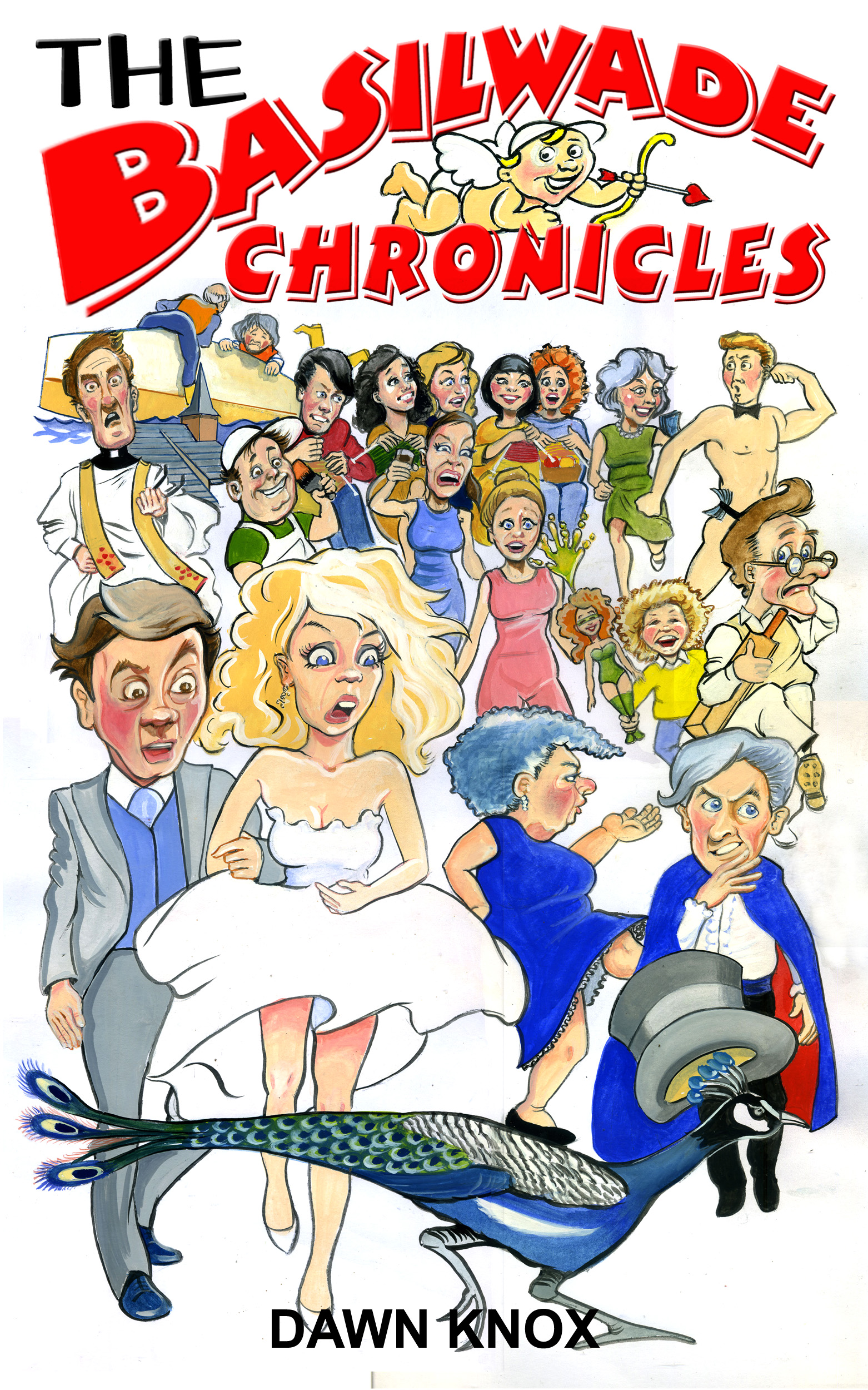
The Basilwade Chronicles
The Awards are run by Edward Trayer, also known as Billy Bob Buttons, and the judges for the adult books are two reading groups, one in London and one in Stockholm, who award points based on editing, theme, style and book cover.
Accompanying the notification, I received a medal which I can put on the book cover, and a certificate, and of course, there is still a chance that The Basilwade Chronicles might be a winner. The results will be announced at the beginning of April 2021.
Wishing Shelf Book Awards Finalist Certificate
However, at the moment, I am thrilled to have reached the list of finalists! If you would like to judge for yourself about the book, it is published by Chapeltown books and is available on Amazon, here as a paperback, an e-book and also an audiobook which is read by the narrator, John Guest. If you’d like to listen to a sample chapter, click here
You can read more about how the book came to be written here.
So Friday, the 12th of February 2021 was a great day. Oh, and by the way, so far I haven’t had any side-effects from my vaccination!
Kissing Frogs and Other Quirky Fairy Tales – One good thing which has come about during the restrictions of the COVID-19 pandemic has been that despite living thousands of miles from Hawaii, I have joined a Hawaiian book club. And that means I have made new friends, and that has led to me submitting stories to a fractured fairy tale anthology which the Hawaii Fiction Writers have put together to raise money for the Aina Haina Public Library (where Hawaii Fiction Writers met during “old-normal” times) and Kapolei Public Library (where they did book and story readings for Halloween and Valentine’s Day during “old-normal” times).
Cover for Kissing Frogs and Other Quirky Fairy Tales
My two stories Worse Than Bungling and Rivalry Most Royal have been accepted for Kissing Frogs and Other Quirky Fairy Tales which was released yesterday as a paperback. You can find it here on Amazon
So how did that happen? Well my friend in Hawaii, David Jones and I have been in contact via email for many years, although we’ve never met face to face. During the first British lockdown, David selected my book The Basilwade Chronicles as his book choice of the month for his book club. Because of the pandemic, his book club were not able to meet in person in the Coffee Talk shop in Honolulu, where they usually gather, David planned to set up a virtual meeting via Jitsi and he invited me to join in too.
David and I had a preliminary meeting to see how good the link up would be and for the first time for the dozen or so years since we’d been emailing, we finally spoke face-to-face.
And then I met other members of the book club at the meeting when they discussed The Basilwade Chronicles. At the end of the meeting I was asked if I would like to join their book club and of course I jumped at the chance!
Never having belonged to a book club, I wasn’t sure what to do but David‘s wife, Shauna, sends out emails and I am included in those. During the meetings I’ve met Michael Little who is the editor of Kissing Frogs and Other Quirky Fairy Tales and I’m thrilled that he accepted two of my stories for his anthology.
Just in case fractured fairytales is not a term you’re familiar with, it takes a classic fairy tale or children’s story and adds a twist, changes characters, or makes it more modern. Michael and Gail Baugniet edited the book and I understand that another member Carole Catanzariti was involved as well. Sadly Carol passed away a few weeks ago. She was obviously well-loved judging by the messages in the emails in which I have been included. You can read the title story of the Kissing Frogs anthology and see the book’s table of contents here on the Hawaii Fiction Writers blog.
As well as editing, Gail designed the cover and Michael formatted and uploaded the finished manuscript to Amazon to be published.
The foreward was done by Jane L. Mickelson, a cultural mythologist and the longtime host of the radio show Questing on radio station KWMR, interviewing people who use mythology and story in their work. Jane interviewed Michael a few weeks ago on her radio show and they discussed the forthcoming Kissing Frogs anthology.
So, I’d like to thank all my friends in Hawaii for welcoming me into their community. Find out more about them:
Spotlight on Author, Gail Aldwin – I’m pleased to introduce fellow author, Gail on my blog today. We’ve known each other for several years and as well as both appearing in the same Bridge House books, we are both members of the Society of Women Writers and Journalists (SWWJ). Recently, Gail let me loose on her blog which you can see here…
So, without further ado, please meet Gail…
Spotlight on Author, Gail Aldwin
Hello, followers of Dawn’s blog. I’m Gail Aldwin, a fellow Bridge House Publishing author who appears in print and online anthologies alongside Dawn’s stories. When Dawn suggested a blog swap, I was stumped for what to share. Then I remembered the term ‘5W and 1H’ which was introduced during mediation training years ago. Fortunately, the principle of using open-ended questions has stuck. The five Ws relate to question starters when, where, what, why and who, the one H relates to how. I thought it might be interesting to use this as a basis for a blog post on writing. Thanks, Dawn, for inviting me onto your blog.
About Gail Aldwin
Gail Aldwin is a novelist, poet and scriptwriter. Her debut novel The String Games was a finalist in The People’s Book Prize and the DLF Writing Prize 2020. Her first children’s picture book Pandemonium was warmly received. In 2021, Gail’s second novel This Much Huxley Knows will be released. It tells the story of community tensions during Brexit from the viewpoint of a seven-year-old narrator. Gail regularly appears at literary and fringe festivals. Prior to Covid-19, Gail volunteered at Bidibidi in Uganda, the second-largest refugee settlement in the world. Her home overlooks water meadows in Dorset.
Why do you write?
As humans, I think we all need a creative outlet. For others, it may be cooking or gardening or painting, but for me, it’s all about writing. I find the whole process absorbing: from the terror of a blank page to the gruelling process of getting a first draft down. The drafting and redrafting bring joy. I love the way stories become nuanced and layered with more detail and crafting applied. I find nailing the plot the biggest challenge and when it’s done, this brings the greatest satisfaction.
What do you write?
Like most other people, there are shopping lists, birthday cards, emails even the odd letter. Of course, my most focused forms of writing are for publication and include contemporary novels, poetry and short fiction. I also co-write plays and comedy sketches that have been performed at venues in Dorset, Brighton and Salisbury. When I set out in 2009 to become a published writer, I never imagined I would also have a children’s picture book published. Writing for children was the last thing on my mind! It was while working as a lecturer delivering input on children’s books to students at the University of South Wales that I struck upon the idea for Pandemonium. Over the years the idea for a cheeky panda causing havoc in a department store developed. The proposal for a full-colour children’s picture book aimed at 2–7-year-olds was accepted by Victorina Press and Fiona Zechmeister appointed as the illustrator. It was then the intensive collaborative work began to ensure the text told one story and the illustrations told a parallel and more nuanced version.
Who do you write for?
When writing fiction, I always have the reader in mind. I strike upon one person (usually female) and create an imagined dialogue with them as the work progresses. I don’t go as far as giving them a name but I’m pretty clear about their age, family commitments, work, interests etc. When I’m sure about who I’m writing for, it’s easier to tailor the voice of my characters and the plot to its readership. Without this in mind, my story could easily get wildly out of hand and go down all sorts of avenues and dead ends. For poetry, the process is different with a focus on patterns of words and images.
When do you write?
Starting out as a writer, I was still working as a teacher and bringing up my two children. I got up at 5 am each weekday to secure quiet time dedicated to writing. I no longer have a day job but I continue to get up early to complete a few writing tasks before breakfast. With more free time, I approach writing flexibly. If I don’t sleep well, you’ll find me tapping away at my laptop. It’s not good sleep hygiene but when ideas are flying around my head, I like to pin them down.
Where do you write?
I share a desk with my husband in a back bedroom of our Dorset home. He has the lion’s share of the space and I’m bundled at one end. I don’t mind because when I’ve got my head down, the writing environment really doesn’t matter much. So long as it’s quiet and there’s a power point, I simply plug in my laptop and get to work.
How do you write?
Plotting is the most difficult part of writing a novel. I now plan to the nth degree before committing a word to the page. In the past, I’ve wasted too much time writing without knowing where the story was going to attempt that again. I write most things on a laptop but I always have a notebook at my side and my diary. I like to set deadlines and make ‘to do’ lists which help to keep me on top of the process. Writing a novel is an unwieldy beast only tamed by good organisation! When working collaboratively on comedy sketches and scripts, my co-writers and I use an online website called WritersDuet. This enables us to work on one document from our different homes and we talk using a WhatsApp group call. This works well and I even contributed to some comedy sketches using this method while I volunteered in Uganda.
Thank you for giving me the opportunity to appear on your blog, Dawn. Here are some details of my latest publication Pandemonium a children’s picture book for youngsters 2–7 years.
Spotlight on Author, Gail Aldwin – Pandemonium
About Pandemonium
Peta doesn’t look like other pandas in the toy department because of her purple coat. This provides camouflage and enables her to get up to mischief. When an assistant spots Peta this puts an end to her tricks. Peta must learn more about herself … but does this stop Peta’s fun? Of course not!
Praise for Pandemonium
Pandemonium is absolutely delightful! Peta the panda is stuffed full of fun and young ones will adore her. Wendy White, Tir na n-Og Award Winner
The beautiful illustrations are full of movement and excitement, and the joyous story will appeal to young children and their parents. Liz Poulain, children’s author and illustrator
Either Deirdre or BabsBabs or Deirdre – one or the other!
Please allow me to introduce you to Babs and Deidre or Deidre and Babs. I have no idea which one is which. Although later in the book, Deirdre does something which makes it easy to distinguish her from Babs.
But then Deirdre is a rabbit. And you know what rabbits do.
Babs, of course, is also a rabbit. However, in the book, she doesn’t do what rabbits do. Well, not that I know about, anyway. And if she does, she keeps pretty quiet about it.
Babs and Deirdre (or Deirdre and Babs) are both teenage rabbits with a penchant for social media and they often reduce life and its vagaries to hashtags. For example, if they were to suggest you buy this book, you might hear either of them utter, #TheMacaroonChroniclesRocks or #BuyThisBook or indeed, #GetYourCopyNow.
#SeeWhatIMean? They are also keen on selfies and are probably well-known influencers on the Isle of Macaroon.They first meet The Three Wise Monkeys on the Custard River where Eddie, Brian and Colin are in a spot of bother in their hired boat, ‘The Saucy Tart’ and Babs and Deirdre perform a daring rescue. Their initial interest in The Three Wise Monkeys result in them appearing on stage alongside Brian, Colin and a very reluctant Eddie, and they earn the name the Jive Bunnies. Quite rightly so, and their good sense and hard work contributes to the friends’ joint enterprise on the desert island. Their motto for life would be #FriendshipRules #FriendshipAboveAll #DeirdreAndBabsForever.
Before I carry on, in the interests of health and safety, please be aware of every move that Gideon makes. If he fishes in one of his pockets – especially if he pulls out a pen, please take evasive action if you value your well-being and your life. As a spy – albeit one who failed his spying exams – Gideon had access to an extensive collection of espionage gadgets such as pens which fire poisoned darts, and others which contain special ink. His inability to distinguish between them contributed to him failing his Spying exams. Consequently, he’s just as likely to shoot you with a sleeping draft-tipped dart as to sign and give you a cheque whose amount will magically alter after he’s gone.
Cultured and good natured, Gideon is the perfect gentleman in his elegant suit and bow tie but unfortunately, his outfit is smarter than his wits. He’s a later addition to the band of chums, however, Gideon is eagerly accepted for his occasional flashes of brilliance and his all-round good humour.
He now plays with The Three Wise Monkeys. Well, why not? The Three Wise Monkeys only contain one monkey, one lemur, two rabbits and a reluctant chicken – so why not a pig? And he’s an excellent flautist. Sadly, that’s a bit unnerving for the other band members, who duck whenever Gideon is holding anything which resembles a blow pipe, especially if they’re looking down its barrel.
Gideon’s motto for life would be: Friendship above everything, and try not to kill any friends by accident.
First, before I say anything about Colin, I need to tell you he’s a lemur and not a monkey like Brian. It’s an easy mistake to make but not one that will win you any favours with Colin, who’s rather touchy on the subject.
When Colin and Brian met Eddie, they were in a musical band and they called themselves ‘Frog’s Scorn’. They engaged Eddie to manage them and he changed their name without consulting either of the band members, to ‘The Three Wise Monkeys’. Of course, you’ll immediately notice the two flaws here – the band actually consists of one monkey, one lemur and nobody else. And it’s also doubtful whether either Colin or Brian possess much wisdom between them – a point underlined by the fact they were the ones who engaged Eddie as their manager. However, Colin is a gentle soul, (unless, of course, you refer to him as a monkey) and as the story progresses he becomes acquainted with the female side of his character and embraces it fully. Nevertheless, he is still a demon on the bongos and together the monkey and the lemur, as ‘The Three Wise Monkeys’ can rock Spudwell Stadium – or indeed any stadium. They have two groupies in Babs and Deirdre who add to the spectacle, and on one notable occasion, Eddie joined them on stage, however that owed more to the threat from the music promoter, Mr Krapowski, than to any musical direction. And in the latter part of the story they are joined by Gideon who plays a mean flute, and it’s interesting to watch his pig’s trotters fly over the instrument. Incidentally, you may notice the others duck or flinch if it appears the flute is pointing at them, because no one can forget how projectiles are frequently emitted from Gideon without his knowledge or intention – some even lethal. Colin is a good-natured chap and a loyal friend so it’s no surprise that his motto for life is: Friendship above all – especially with my mate Brian.